
Install the app
How to install the app on iOS
Follow along with the video below to see how to install our site as a web app on your home screen.
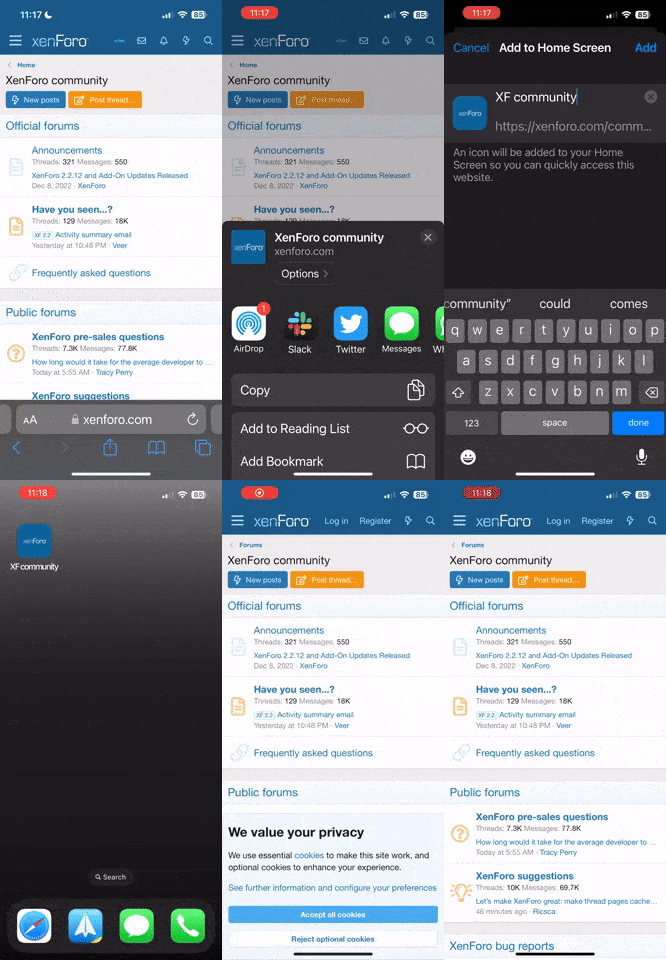
Note: This feature currently requires accessing the site using the built-in Safari browser.
You are using an out of date browser. It may not display this or other websites correctly.
You should upgrade or use an alternative browser.
You should upgrade or use an alternative browser.
which linux flavour to try next ?
- Thread starter donkey42
- Start date

Anti-Trend
Nonconformist Geek
which next ?
Have you tried Debian? It's more difficult to setup & configure than Ubuntu, but IMHO it's a much better platform. I'm actually running Debian "Etch" (currently "testing") right now; I figured I'd been running Mandrake/Mandriva for too long and I was developing a monoculture. Deb's a good platform and I really like it so far.i´m now thinking of trying a new flavour of linux, what does anyone suggest
which next ?
What are you looking for in a distro?
For that system I would recommend something in the middle-weight to light-weight catergory.
Good choices for speed:
Gentoo
Slackware
freeBSD
Arch
Good choices for ease of use and decent speed:
VectorLinux
DesktopBSD
PC-BSD
The newest Xandros has got great reviews if you want to go the commercial way.
Read this at distrowatch. Its a good overview of the 10 most popular distros.
Really it all depends on what you want out of your computer.
What are you looking for in a distro?
For that system I would recommend something in the middle-weight to light-weight catergory.
Good choices for speed:
Gentoo
Slackware
freeBSD
Arch
Good choices for ease of use and decent speed:
VectorLinux
DesktopBSD
PC-BSD
The newest Xandros has got great reviews if you want to go the commercial way.
Read this at distrowatch. Its a good overview of the 10 most popular distros.
Really it all depends on what you want out of your computer.

megamaced
Geek Geek Geek!
which next ?
SHOCK! HORROR! :eek:
You've moved away from Mandriva? I never thought I'd live to see the day. Wow, something to tell my kids about when I'm older ;) .....
I figured I'd been running Mandrake/Mandriva for too long and I was developing a monoculture
SHOCK! HORROR! :eek:
You've moved away from Mandriva? I never thought I'd live to see the day. Wow, something to tell my kids about when I'm older ;) .....

zeus
out of date
which next ?
Linux Distribution Chooser [© 2005-06 - zegenie Studios]
A quesionaire helping you choose.
Linux Distribution Chooser [© 2005-06 - zegenie Studios]
A quesionaire helping you choose.

donkey42
plank
which next ?
no, chill out, LOL, i´m not moving away from mandriva, just thought instead of dipping my toe into the pool that is linux, i thought i´d stick my leg in (hope it doesn´t get chewed off by summert but i´ll keep mandriva on the HDD its on, just try a few distros, plenty to do for a few weeks now, thanks guys
SHOCK! HORROR! :eek:
You've moved away from Mandriva? I never thought I'd live to see the day. Wow, something to tell my kids about when I'm older ;) .....
no, chill out, LOL, i´m not moving away from mandriva, just thought instead of dipping my toe into the pool that is linux, i thought i´d stick my leg in (hope it doesn´t get chewed off by summert but i´ll keep mandriva on the HDD its on, just try a few distros, plenty to do for a few weeks now, thanks guys
think i´ll give that a blast, see what happensHave you tried Debian?
then i think i´ll give these a trykenji-san said:VectorLinux
DesktopBSD
PC-BSD
megamaced
Geek Geek Geek!
which next ?
No, no, that comment was aimed at AT :)
But I do think it would be a good idea to stick with one distro and learn it. Then, when you've gained enough experience, should you check out what else is on offer. The first distro I used was SuSE, and I stuck with it for about 4 months (despite how much it :swear: me off at times) until I moved to (X/K)Ubuntu.
no, chill out, LOL, i´m not moving away from mandriva,
No, no, that comment was aimed at AT :)
But I do think it would be a good idea to stick with one distro and learn it. Then, when you've gained enough experience, should you check out what else is on offer. The first distro I used was SuSE, and I stuck with it for about 4 months (despite how much it :swear: me off at times) until I moved to (X/K)Ubuntu.
Anti-Trend
Nonconformist Geek
which next ?
Debian really is a nice distro, it just requires that either you know a thing or two about Linux/UNIX, or else you need to be willing to RTFM. :) I may actually go back to Mandriva when 2007 comes out, but for the time being, Deb is a great desktop. I'm quite pleased with the performance and how easy it was to make it "my distro" without having to use a source-based distro. [ot]IMHO, distros like Gentoo are ironic, because they spend hours and hours of CPU time trying to make the OS as efficient for the hardware as possible. So... spending weeks of CPU time to gain milliseconds of performance? Maybe I'm missing something. Definately sounds has the earmarks of a hobbyist distro to me. [/ot]
I think Mandriva is one of the very best distros, which is why I've used it exclusively on my primary desktop for years now. However, all my systems run some Red Hat variant (which is how Mandriva first started out, so it's designed similarly) so I figured it might be good to clock some time on the OS I started out on years ago -- Debian.SHOCK! HORROR! :eek:
You've moved away from Mandriva? I never thought I'd live to see the day. Wow, something to tell my kids about when I'm older ;) .....
Debian really is a nice distro, it just requires that either you know a thing or two about Linux/UNIX, or else you need to be willing to RTFM. :) I may actually go back to Mandriva when 2007 comes out, but for the time being, Deb is a great desktop. I'm quite pleased with the performance and how easy it was to make it "my distro" without having to use a source-based distro. [ot]IMHO, distros like Gentoo are ironic, because they spend hours and hours of CPU time trying to make the OS as efficient for the hardware as possible. So... spending weeks of CPU time to gain milliseconds of performance? Maybe I'm missing something. Definately sounds has the earmarks of a hobbyist distro to me. [/ot]
which next ?
I agree, Debian is great. Very stable and not as hard to use as source distros.
I am not a gentoo activist but I used it for 9 months a few years ago. Here is the deal with source distros:
1: compiling from souce gives you options. It is not just about CPU optimizations. For instance if you use KDE and are compiling a program with optional support for gnome, you can leave that gnome crap out. This saves space on your hard drive, makes the software more efficient and relevant to your system and saves memory.
2: CPU optimizations can make a big difference in performance. Having software that uses all of your hardware to its fullest potential is a big plus for some people, especially on older systems.
3: Compiling does not neccessarily 'hog' your system resources. Besides, you can always use the 'nice' command to force gcc to use 'spare' CPU cycles and you can use your system normally while compiling in the background.
I use desktopBSD, a freeBSD derivative. I have the option of installing packages or compiling from source whenever I wish. I like the freedom this gives me and I only compile stuff that would give me performance benifit, is a newer version than the package, or has an option that I can do without. Usually I use packages.
Wow, sorry for rambling, just wanted to throw in my 2 cents.
Debian really is a nice distro, it just requires that either you know a thing or two about Linux/UNIX, or else you need to be willing to RTFM. I may actually go back to Mandriva when 2007 comes out as, but for the time being, Deb is a great desktop. I'm quite pleased with the performance and how easy it was to make it "my distro" without having to use a source-based distro.
I agree, Debian is great. Very stable and not as hard to use as source distros.
Off Topic:
IMHO, distros like Gentoo are ironic, because they spend hours and hours of CPU time trying to make the OS as efficient for the hardware as possible. So... spending weeks of CPU time to gain milliseconds of performance? Maybe I'm missing something. Definately sounds has the earmarks of a hobbyist distro to me.
I am not a gentoo activist but I used it for 9 months a few years ago. Here is the deal with source distros:
1: compiling from souce gives you options. It is not just about CPU optimizations. For instance if you use KDE and are compiling a program with optional support for gnome, you can leave that gnome crap out. This saves space on your hard drive, makes the software more efficient and relevant to your system and saves memory.
2: CPU optimizations can make a big difference in performance. Having software that uses all of your hardware to its fullest potential is a big plus for some people, especially on older systems.
3: Compiling does not neccessarily 'hog' your system resources. Besides, you can always use the 'nice' command to force gcc to use 'spare' CPU cycles and you can use your system normally while compiling in the background.
I use desktopBSD, a freeBSD derivative. I have the option of installing packages or compiling from source whenever I wish. I like the freedom this gives me and I only compile stuff that would give me performance benifit, is a newer version than the package, or has an option that I can do without. Usually I use packages.
Wow, sorry for rambling, just wanted to throw in my 2 cents.
Anti-Trend
Nonconformist Geek
which next ?
I don't necessarily believe source-based distros are too hard to use for the initiated, but I definately wouldn't recommend them for the new or casual user. I just don't like the inconvenience of needing to take hours of time just for portage to build and install a single app. Besides, I used Gentoo for quite a while myself, and I noticed that many binary distros perform as well or better in some situations.I agree, Debian is great. Very stable and not as hard to use as source distros.
Agreed, it's very nice to have a custom fit for software; both to your hardware and your individual needs. However, binary distros have the advantage that the software has been run with the exact same build options on thousands of machines. It's much more likely to be stable and less likely to be buggy when you introduce new software.1: compiling from souce gives you options. It is not just about CPU optimizations. For instance if you use KDE and are compiling a program with optional support for gnome, you can leave that gnome crap out. This saves space on your hard drive, makes the software more efficient and relevant to your system and saves memory.
Ironic that you say that, since it takes older systems the longest to build from portage. But no argument from me that once it's up, optimizations and lean compiling practices definately make for a faster system, especially so on lower-end hardware which struggles to run every app.2: CPU optimizations can make a big difference in performance. Having software that uses all of your hardware to its fullest potential is a big plus for some people, especially on older systems.
Yes, I always nice my make jobs at 19. At that priority, you really don't feel the hit on your system performance at all, except perhaps on RAM. But it's still a long process just to accomplish what a non-source distro would accomplish in a few seconds.3: Compiling does not neccessarily 'hog' your system resources. Besides, you can always use the 'nice' command to force gcc to use 'spare' CPU cycles and you can use your system normally while compiling in the background.
I've found that personally, the time spend compiling trivial software is not worth the payoff. IMHO, multimedia apps, performance-oriented programs and the kernel itself give the biggest payoff for the time investment of rolling it yourself. On my desktops, I always run a custom-rolled kernel.I use desktopBSD, a freeBSD derivative. I have the option of installing packages or compiling from source whenever I wish. I like the freedom this gives me and I only compile stuff that would give me performance benifit, is a newer version than the package, or has an option that I can do without. Usually I use packages.
Don't apologize, your input brings some balance to my argument. :) If people were to base their concepts of Gentoo and other source-based distros off of my comments alone, they might get the wrong idea. And perhaps I have come off too strong; if so, apologies. :) But my primary point was and is that source-based distros are a waste of time for most people. I suppose I am just cynical because of the ricer mentality a lot of Gentoo kiddies hold.Wow, sorry for rambling, just wanted to throw in my 2 cents.
But my primary point was and is that source-based distros are a waste of time for most people.
I agree. Mostly it would be wasted time for a casual user. I wouldn't ever go back to gentoo. I also would never use an RPM distro again, but that is just my preference.
I've found that personally, the time spend compiling trivial software is not worth the payoff. IMHO, multimedia apps, performance-oriented programs and the kernel itself give the biggest payoff for the time investment of rolling it yourself. On my desktops, I always run a custom-rolled kernel.
Totally. I upgraded KDE to 3.5.3 by compiling from source because only 3.5.1 was available as a package and it made a HUGE performance difference in graphics and responsiveness. I compile all my multimedia stuff, when I have time ;)
I love the balance I get with BSD. Source when I want it, packages when I don't. Super stable, very customizable and overall very well built. >15,000 packages isn't too bad either. There isn't anything that I looked for and haven't found in the repos.
megamaced
Geek Geek Geek!
I also would never use an RPM distro again, but that is just my preference
Yep, I am with you on that one :)
SuSE's lack of decent repositories has put me off. I always used to get circular dependencies, one after another. It used to drive me crazy!
Debian's repositories are huge (or ubuntu in my case) and i've never experienced a dependency problem since I moved away from SuSE.
Anti-Trend
Nonconformist Geek
IMHO, RPM is fine for a package format, as long as you have good repos and a good package manager. I remember RPM hell on older versions of RH almost putting me off of Linux/UNIX completely way back. But package managers like urpmi and yum make apt/deb/ports seem like a lot less of a big deal. One of the benefits of open-source I guess; one distro's improvement can benefit them all....I also would never use an RPM distro again, but that is just my preference.
Anti-Trend
Nonconformist Geek
Heh, sorry, we kinda hijacked your thread huh?alright, you guys lost me a while ago, but to bring this conversation back down to earth, do i need to download DVD 2 from here or do i just need DVD 1 of debian
Back on topic, if you have broadband with a decent FAP, you can actually just download the net install version and download the bulk of the packages from the 'net. There are three version of Debian:
- Stable -- Currently "Sarge" -- Sarge is the stabalized release which doesn't change often and most of the packages are of the older persuasion. Perfect for important systems where stability is the key ingredient, but don't expect any flashy new software.
- Testing -- Currently "Etch" -- Etch is the release candidate for the next stable version, and as such has new packages and changes somewhat often. A good balance of new vs. stable, Testing is good for a typical desktop. After the Testing version has been around long enough, it is frozen into "Stable".
- Unstable -- Always called "Sid" -- Sid is the bleeding-edge release. It's always running the latest packages, so it's the testbed for the Testing version. As such, it has the potential to be unstable, just like Sid in Toy Story.
For a desktop I recommend running Etch, which is current enough to be quite relevant and yet much more stable than Sid.
P.S. > The DVDs you linked to are of Etch.
donkey42
plank
Heh, sorry, we kinda hijacked your thread huh?
[ot]it´s not a problem, i understood a lot of it, but i had to duck for some of it otherwise it would have hit me right between the eyes[/ot]
but do i need disc 2 ?
but do i need disc 2 ?
I would say no. You are better off installing software from a repository because it will be more up to date. I don't see where there is a disc 2 for dvd release but usually additional discs are only more software, nothing you would need to get up and running. Just wastes bandwidth to get a bunch of out of date stuff that you won't install.
Anti-Trend
Nonconformist Geek
Yep, I agree totally. That's why I recommended the net install version, if it's plausible for you to install that way.I would say no. You are better off installing software from a repository because it will be more up to date. I don't see where there is a disc 2 for dvd release but usually additional discs are only more software, nothing you would need to get up and running. Just wastes bandwidth to get a bunch of out of date stuff that you won't install.
donkey42
plank
I would say no. You are better off installing software from a repository because it will be more up to date. I don't see where there is a disc 2 for dvd release but usually additional discs are only more software, nothing you would need to get up and running. Just wastes bandwidth to get a bunch of out of date stuff that you won't install.
so, if i started install using disc1, how would i chang the install type (from DVD media to FTP, or would i have to full install from FTP, not that i know how to do either)