
Install the app
How to install the app on iOS
Follow along with the video below to see how to install our site as a web app on your home screen.
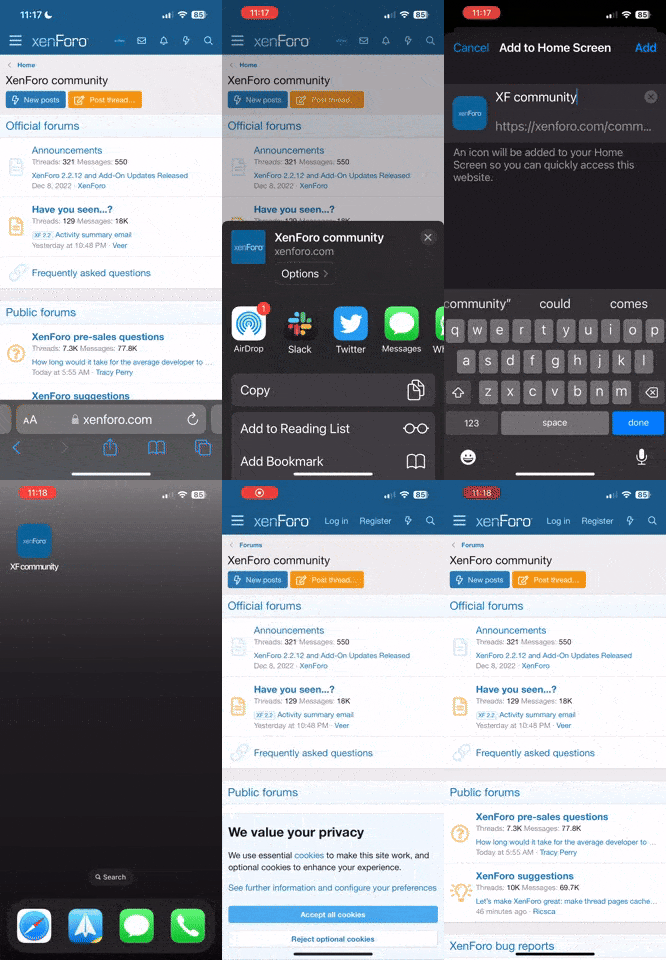
Note: This feature currently requires accessing the site using the built-in Safari browser.
You are using an out of date browser. It may not display this or other websites correctly.
You should upgrade or use an alternative browser.
You should upgrade or use an alternative browser.
Old computer, new storage?
- Thread starter harakim
- Start date

megamaced
Geek Geek Geek!
Some new motherboards allow you to boot from a flash drive. If your motherboard is one of them, there will be an option in the BIOS that says 'enable boot from USB' or such like. I have never heard of someone wanting to actually run a whole OS of one! :confused: You would have serious performance issues! A USB flash drive (even if it's USB 2.0) is much, much slower then a local disk.
As for your hard drive, you need to be more specific as to what interface it uses etc. Sometimes, flashing the bios will allow a motherboard to address more hard drive space.
As for your hard drive, you need to be more specific as to what interface it uses etc. Sometimes, flashing the bios will allow a motherboard to address more hard drive space.

harakim
Big Geek
I was under the impression (from a guy at best buy) that flash drives were faster than hard drives!
I'm not sure what interface my hard drive uses and I don't know how to tell. What I'm trying to do is get a system set up where I can practice programming an operating system, so I thought how nice it would be to have a flash drive so I can program then just bring it downstairs, heh. I guess its back to 3,5 floppy.
But anyway, what are the different kinds of interfaces so I know what to look for?
I'm not sure what interface my hard drive uses and I don't know how to tell. What I'm trying to do is get a system set up where I can practice programming an operating system, so I thought how nice it would be to have a flash drive so I can program then just bring it downstairs, heh. I guess its back to 3,5 floppy.
But anyway, what are the different kinds of interfaces so I know what to look for?
Flash drives with USB 2.0 may be faster in reading data, but overall latency and write speeds aren't as good as HD interfaces.
If you want to see what an OS looks like try taking a look at the linux kernel source code if you're brave.
You can run an OS from it, example with some tiny linux distros the data is just read and mounted into a ramdisk where its stored temporarily and can be accessed very quickly.
USB 2.0 is much faster in read/write than 1.1 but all USB 2.0 devices are backward compatible with USB 1.1 devices albeit at a much slower speed; and thats about the only common one. Haven't heard of a firewire flash drive.
If you want to see what an OS looks like try taking a look at the linux kernel source code if you're brave.
You can run an OS from it, example with some tiny linux distros the data is just read and mounted into a ramdisk where its stored temporarily and can be accessed very quickly.
USB 2.0 is much faster in read/write than 1.1 but all USB 2.0 devices are backward compatible with USB 1.1 devices albeit at a much slower speed; and thats about the only common one. Haven't heard of a firewire flash drive.
megamaced
Geek Geek Geek!
Addis said:Flash drives with USB 2.0 may be faster in reading data, but overall latency and write speeds aren't as good as HD interfaces.
That is not true. Flash drives are much slower then hard drives
Anyway, back to the question! First we need to find out if you have connected your hard drive properly.
Make sure the hard drive is connected firmly to the end of the IDE cable, and not connected to the middle. That is used for secondary hardware such as a CD-ROM.
I would then suggest you check the jumper settings on your hard drive. You must make sure your hard drive is set to master. Normally, the pin configurations are marked out on the device. If not, you will need to 'google' a manual for your model.
Next you need to find out if your BIOS recognises your device. If you are using an Award BIOS, you need to go into 'Standard CMOS settings'. Other BIOS might call it something like IDE configuration. If you are using a non-clone system (a retail system such as a brand ie. Siemens, Emachines) you might be limited as to what you can change.
Once there, you need to set your IDE configuration to autodetect.
When your computer next reboots, it will look for your drive in the POST.
harakim
Big Geek
Thanks, Jonbenge, I think you were pretty much exactly on.
I made sure it was firmly attached to the same one as the already working drive (which was the end), and it had the same settings as it did in my other computers when it worked.
Anyway, the drive doesn't work still and it's an IBM, so I can't edit my IDE Settings when there is no drive present. I guess I'll just have to hope that my old drive doesn't fail or else back up anything I need. Most likely, I won't have anything important on it I take it.
Just in case, is there anywhere to get old hard drives in new condition?
Thanks for the immense amount of help, I really appreciate it a lot.
I made sure it was firmly attached to the same one as the already working drive (which was the end), and it had the same settings as it did in my other computers when it worked.
Anyway, the drive doesn't work still and it's an IBM, so I can't edit my IDE Settings when there is no drive present. I guess I'll just have to hope that my old drive doesn't fail or else back up anything I need. Most likely, I won't have anything important on it I take it.
Just in case, is there anywhere to get old hard drives in new condition?
Thanks for the immense amount of help, I really appreciate it a lot.
megamaced
Geek Geek Geek!
harakim said:Just in case, is there anywhere to get old hard drives in new condition?
Ebay...